
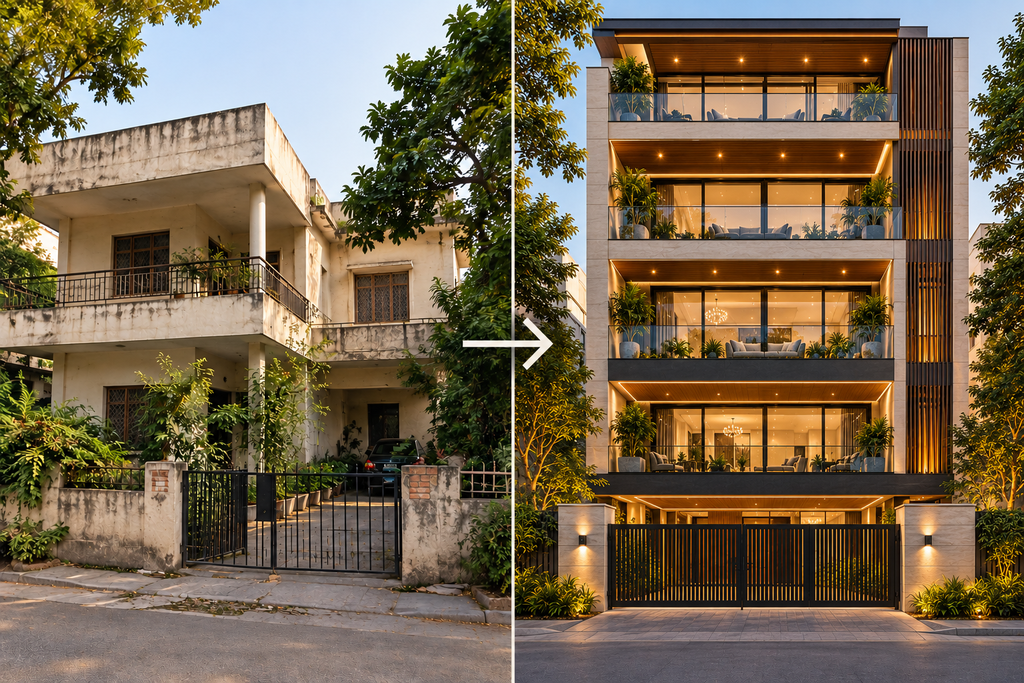
South Delhi is home to some of Delhi’s most established residential neighbourhoods, where generations of families own independent houses, ageing bungalows and valuable residential plots. While many of these properties occupy desirable locations, their existing structures may no longer meet modern expectations for comfort, accessibility, parking or design.
For property owners, this raises an important question: Should you continue maintaining an old house, sell the property, or explore redevelopment?
Property redevelopment in South Delhi offers an alternative to selling your land outright. Depending on the property’s legal status, location, permissible construction and financial feasibility, redevelopment may allow owners to retain a stake in the property while creating modern residential spaces.
At South Delhi Builders, we believe that an informed decision begins with understanding your options, the associated costs and the legal requirements—not with making unrealistic promises.
What Is Property Redevelopment?
Property redevelopment involves replacing or substantially reconstructing an existing residential structure to create a more functional, modern building.
For eligible properties, this may mean transforming an ageing independent house into a contemporary building with luxury builder floors, improved layouts, modern amenities, parking provisions and elevator access where feasible and legally permissible.
Redevelopment can be particularly relevant for:
- Families living in old independent houses that require extensive repairs.
- Owners of residential plots in established South Delhi neighbourhoods.
- Families looking to unlock value from ancestral property.
- Senior citizens seeking modern, more accessible living arrangements.
- NRIs who want to manage their property in India through a reliable professional team.
However, redevelopment is not automatically the best choice for every property. The plot’s characteristics, ownership structure, applicable regulations, construction costs and the family’s objectives all need to be evaluated.
Four Ways to Redevelop or Monetise Your South Delhi Property
One of the first steps is deciding which development model suits your requirements.
1. Builder Collaboration: Develop Without Funding the Entire Construction
A builder collaboration, often structured through a joint development or other contractual arrangement, allows a landowner to partner with a developer.
Under the agreed arrangement, the developer may finance and manage construction while the landowner contributes the property rights specified in the agreement. In return, the owner receives an agreed allocation of floors or units and, where negotiated, additional financial compensation or other benefits.
For example, a family owning an eligible residential plot may explore an arrangement under which a developer constructs a new building and the family retains specified completed floors.
Potential benefits of builder collaboration include:
- Access to professional construction management.
- Reduced need for the owner to fund construction directly, subject to the agreement.
- An opportunity to retain ownership or agreed property interests.
- Potential future rental income from retained units.
- Modern construction and amenities, subject to approved plans and specifications.
What should landowners verify?
The agreement should clearly define the allocation of floors, construction specifications, funding responsibilities, project milestones, delay provisions, taxes, approvals, possession conditions and remedies in case of default.
A collaboration is not risk-free, and the owner should obtain independent legal and tax advice before signing.
Explore our property collaboration and development services to understand the available options.
2. Outright Sale: Convert Your Property into Immediate Capital
An outright sale involves transferring the property to a buyer for an agreed purchase price, subject to the applicable legal formalities.
This may suit owners who want liquidity rather than a continuing interest in a redevelopment project.
Potential advantages include:
- A defined sale consideration under the transaction documents.
- No ongoing responsibility for managing redevelopment after completion of the sale.
- Flexibility to reinvest the proceeds or distribute them among family members.
- A potentially simpler exit from a property that requires significant maintenance.
The sale price should be assessed against comparable properties, the plot’s development potential, ownership documentation and prevailing market conditions.
Owners should also evaluate capital gains tax, transaction costs and any family or succession considerations before proceeding.
3. Turnkey Construction: Retain Ownership and Rebuild Independently
In turnkey construction, the landowner retains ownership and appoints a professional firm to manage the agreed design and construction scope for a fee.
Depending on the contract, services may include architectural design, engineering coordination, material sourcing, approvals assistance, construction supervision and finishing.
This model may suit families who want greater control over the final building and intend to retain all completed units, subject to their ownership rights and the applicable approvals.
Before signing, establish a detailed scope of work, material specifications, payment milestones, variation procedures, quality standards, warranties and the process for handling delays or disputes.
Learn more about our turnkey construction and redevelopment services.
4. Self-Redevelopment Guidance: Plan the Project with Professional Support
Some owners prefer to manage their own redevelopment while engaging architects, engineers, legal advisers and project-management professionals.
Professional guidance can help owners assess the feasibility of their plot, understand applicable regulations, prepare documentation and coordinate the various stages of construction.
This approach offers flexibility but also requires active decision-making, financial planning and oversight from the owner.
Can an Old House in South Delhi Be Rebuilt as Luxury Builder Floors?
The answer depends on the specific property.
Factors that may affect redevelopment feasibility include:
- Plot size and dimensions.
- The property’s title and ownership structure.
- Applicable land-use and building regulations.
- Permissible FAR, ground coverage and setbacks.
- Road width and other site-specific restrictions, where applicable.
- Structural design, fire and safety requirements.
- Parking, access, elevator and utility provisions.
- Approvals required from the relevant authorities.
The concept of stilt parking with multiple residential floors is familiar in parts of Delhi’s residential property market. However, a building configuration that is possible on one plot may not be permissible on another.
Owners should never assume that a particular number of floors can be constructed simply because a neighbouring property has the same configuration. A qualified architect or other appropriate professional should assess the plot against the current rules applicable to that property.
What Does Property Redevelopment Cost in South Delhi?
There is no single construction cost that applies to every South Delhi redevelopment project.
The overall budget can vary substantially depending on the plot, building size, structural requirements, quality of materials, architectural complexity and the scope of interiors and amenities.
A redevelopment budget may include:
- Pre-construction work: Surveys, feasibility studies, architectural design and engineering.
- Demolition and site preparation: Removal of the existing structure and preparation of the plot.
- Civil and structural construction: Foundations, columns, slabs, masonry and related works.
- Building services: Electrical systems, plumbing, water management, lifts and other specified services.
- Finishes and interiors: Flooring, doors, windows, kitchens, bathrooms and other finishes.
- External works: Parking, gates, landscaping and boundary treatments.
- Approvals and professional fees: Applicable statutory charges, consultants and documentation.
- Contingency: An allowance for unforeseen conditions and approved scope changes.
A reliable estimate should be based on a defined design, specification and scope of work. It should also distinguish construction costs from land value, financing costs, applicable taxes and other project expenses.
In a collaboration arrangement, the developer and landowner’s financial responsibilities will depend on the negotiated agreement.
Understanding Legal Approvals and Documentation
Before starting redevelopment, the property’s legal and technical position should be reviewed carefully.
Important checks may include:
- Verification of title and ownership records.
- Identification of co-owners and any required consents.
- Review of existing encumbrances, disputes or restrictions.
- Assessment of the applicable sanctioned building plan requirements.
- Verification of current FAR, setbacks, ground coverage and other construction rules.
- Identification of required permissions and completion or occupancy formalities, as applicable.
- Review of the development agreement, construction contract or sale documentation.
For collaboration projects, the agreement should also address what happens if approvals are delayed, costs change, construction falls behind schedule or either party fails to meet its obligations.
Clear documentation and independent professional advice can help reduce misunderstandings and protect both parties’ interests.
Is Redevelopment Better Than Selling Your Old House?
The right decision depends on your financial needs, family circumstances and appetite for project-related risk.
| Factor | Builder collaboration | Outright sale | Turnkey construction |
|---|---|---|---|
| Immediate liquidity | Depends on agreed terms | Generally the main objective | Usually requires owner funding |
| Retaining property | Possible under the agreement | Generally no, after sale completion | Generally yes |
| Construction management | Typically developer-led | Buyer assumes responsibility after sale | Contractor manages the agreed scope |
| Owner involvement | Contract and decision dependent | Usually limited after completion | Generally higher |
| Potential rental income | From retained units, if any | Not from the property once sold | From retained completed units |
| Key consideration | Developer and agreement risk | Sale valuation and transaction costs | Budget, execution and cost overruns |
The comparison is indicative. Actual responsibilities, ownership outcomes and financial consequences depend on the transaction documents and individual circumstances.
For some families, an outright sale provides the certainty and liquidity they need. Others may prefer collaboration to retain completed units. Families seeking maximum control over the final building may consider turnkey construction or self-redevelopment.
Redeveloping Ancestral Property: Consider the Entire Family
An ancestral property can represent decades of memories and substantial financial value. When multiple family members have an interest in the property, redevelopment decisions should account for more than construction feasibility.
Before proceeding, families should establish:
- Who legally owns the property and who must consent.
- How proceeds, completed units or other benefits will be allocated.
- Whether any family member needs immediate liquidity.
- How temporary accommodation and relocation will be handled.
- Who will make decisions if circumstances change during construction.
- How disputes will be addressed under the relevant documents.
For NRIs, additional attention may be needed for authorisations, documentation, tax obligations and coordination with professionals in India.
Transparent communication and a properly documented agreement can help families make decisions with greater confidence.
Why Choose South Delhi Builders?
Choosing a redevelopment partner requires more than comparing proposed floor allocations or construction estimates. Owners should understand the developer’s track record, financial capacity, construction standards and approach to legal compliance.
South Delhi Builders aims to help property owners evaluate their available options and understand the practical steps involved in redevelopment.
A responsible project assessment should consider:
- The property’s ownership and redevelopment feasibility.
- The owner’s priorities and preferred development model.
- Applicable approvals and construction requirements.
- The proposed allocation of responsibilities and financial commitments.
- Construction specifications, project milestones and quality controls.
- Clear documentation and realistic expectations.
Any proposal should be tailored to the specific property rather than based on a generic promise of a fixed number of floors, a guaranteed return or a predetermined completion date.
Explore our services for property owners to learn more about collaboration and turnkey construction options.
Frequently Asked Questions
1. What is property redevelopment in South Delhi?
Property redevelopment involves replacing or reconstructing an existing property to create a modern building, subject to legal ownership, planning regulations, approvals and financial feasibility.
2. Can I redevelop my old house without paying the full construction cost myself?
Potentially. Under a suitable builder collaboration arrangement, the developer may fund the agreed construction work in exchange for the negotiated property allocation or other consideration. The exact arrangement depends on the contract and project feasibility.
3. How many floors can I build on my South Delhi plot?
The permissible building configuration depends on the plot, applicable planning regulations, FAR, setbacks, ground coverage, road and site conditions, and required approvals. A property-specific feasibility assessment is essential.
4. Is builder collaboration better than selling the property?
Neither option is universally better. Collaboration may allow the owner to retain completed units, whereas a sale may provide immediate liquidity. The decision should account for valuation, financial needs, transaction costs, risks and family objectives.
5. Do I have to pay capital gains tax on redevelopment?
Tax treatment depends on the transaction structure, the property’s ownership and holding history, the applicable provisions of tax law and the timing of relevant events. Certain collaboration arrangements may be covered by specific provisions of the Income-tax Act. Obtain advice from a qualified tax professional before relying on any estimated tax outcome.
6. How long does property redevelopment take?
Timelines depend on design, approvals, demolition, construction complexity, funding, contractor performance and site conditions. A project-specific schedule with milestones and delay provisions is more useful than a generic completion promise.
7. What documents should I check before signing a collaboration agreement?
Start with title and ownership records, encumbrance and dispute checks, relevant property documentation, the proposed development terms, construction specifications, approval responsibilities, allocation details, timelines and default remedies. A property lawyer should review the final documents.
Conclusion: Make an Informed Decision About Your Property
An ageing independent house does not necessarily need to remain a maintenance burden, and selling it is not the only possible option.
Property redevelopment in South Delhi may provide an opportunity to create modern residential spaces, retain an agreed interest in completed units or reorganise the property’s value around your family’s needs.
The first step is to understand what your plot legally permits, what the project may cost and which development model best matches your objectives.
Considering redevelopment of an old house or residential plot in South Delhi?
Contact South Delhi Builders to discuss your property, explore the available development models and understand the feasibility of your next steps.
You can also explore our services to learn more about the development solutions available to property owners.
Disclaimer: This article is for general educational purposes and is not legal, tax, investment or architectural advice. Property-specific decisions should be made after obtaining appropriate professional advice and verifying the current rules and requirements applicable to the property.

Leave a Reply